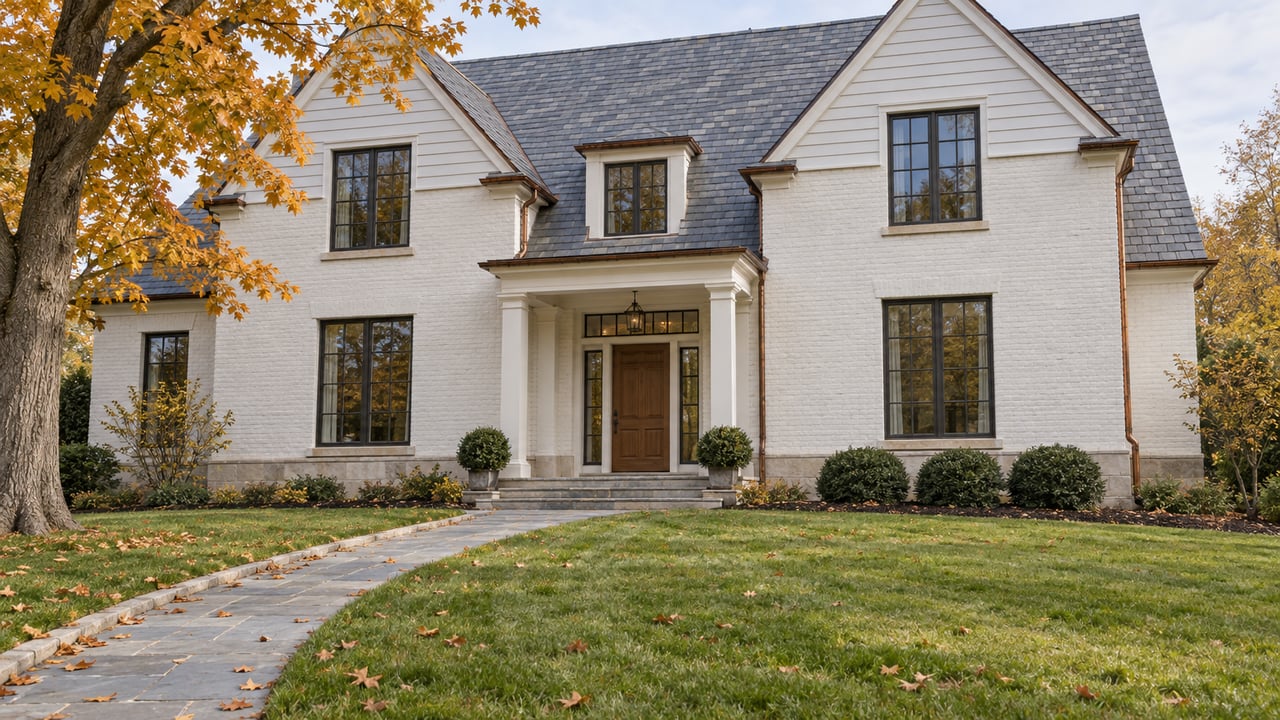
Two colonials, half a mile apart, both carrying a 10583 mailing address. One sits inside the Village of Scarsdale. The other sits in Edgemont, a hamlet of the Town of Greenburgh that has never been part of Scarsdale at all. A buyer touring both this month, working off the zip code alone, could reasonably assume they're comparing two houses under the same local government. They would be wrong, and the gap between what they assume and what's actually true is currently the subject of a court fight that has run for the better part of a decade.
That gap is the thing worth understanding before you write an offer on either side of the line.
The Address Isn't the Government
Edgemont is a census-designated place, not a village. It has no mayor, no board of trustees, and no independent municipal government of its own. What it has is a school district and a fire district, both self-governed by Edgemont residents through their own elections and budgets. Everything else, from zoning and land use to police coverage and general municipal services, is handled by the Town of Greenburgh, the same town that governs Hartsdale and the unincorporated pockets around it. Most of Edgemont's properties happen to fall within the Scarsdale post office's delivery area, which is why the mailing address reads 10583. But the Village of Scarsdale, with its own elected government and its own control over zoning and services, has no jurisdiction over Edgemont whatsoever.
This isn't a technicality. It's the reason two houses that look identical on a listing sheet can sit under two completely different systems of local governance, taxation, and long-term planning, despite sharing a mailing address that suggests otherwise.
What That Difference Actually Costs
The clearest illustration came out of Greenburgh's 2016 townwide property revaluation. Once homes across the town were reassessed to reflect actual market value, it became possible to compare taxes on similarly priced houses in Edgemont and Scarsdale for the first time on an apples-to-apples basis. The result: Edgemont's blended tax rate, covering schools, town, county, fire, and sewer, came out to 3.34%, versus 2.24% in the Village of Scarsdale, a gap of roughly $11,000 a year on a $1 million home. Town Supervisor Paul Feiner himself flagged the disparity in a March 2016 internal email, asking why Edgemont residents were paying so much more.
The mechanism behind that gap is structural, not incidental. Edgemont homeowners pay into several separate taxing authorities, including the Edgemont School District, the Greenville Fire District, the Town of Greenburgh, and Westchester County, each of which sets its own budget and levy independently. Scarsdale residents pay into a village government that controls more of those levers directly. Neither structure is better or worse on its face, but they are not the same structure, and a buyer pricing a home against "comparable Scarsdale taxes" is measuring against the wrong yardstick.
The Same Fight, for the Third Time
This isn't a settled piece of history. It's live. For more than eight years, a group called the Edgemont Incorporation Committee has pushed to convert the hamlet into Greenburgh's seventh incorporated village, joining Ardsley, Dobbs Ferry, Elmsford, Hastings-on-Hudson, Irvington, and Tarrytown as self-governing municipalities within the town. The pitch is straightforward: an incorporated Edgemont would control its own zoning, its own land use decisions, and its own spending, rather than routing all of it through a town where Edgemont represents only about 8% of the voting population.
Twice before, in 2018 and again in 2020, a state Supreme Court judge ordered a referendum, and twice the Town of Greenburgh successfully appealed to have those rulings overturned. In March 2026, News 12 Westchester reported that a state Supreme Court judge ruled for a third time that Edgemont residents should be allowed to vote on incorporation. Supervisor Feiner again said the town would appeal, and reporting this spring put legal costs across the years-long battle at roughly $400,000, with the Town Board approving further funds to continue litigating.
"It would be devastating," Feiner said of the prospect of Edgemont breaking away, citing lost revenue and cuts to town services, according to News 12 Westchester.
The pattern matters more than any single ruling. Every time a court has sided with incorporation, the town has appealed and, twice, won. A buyer should not treat the March 2026 ruling as a signal that Edgemont's governance or tax structure is about to change soon. The realistic read, based on how this has played out twice already, is that the appeal process alone could take considerable time, and the outcome is not guaranteed either way.
What This Means If You're Comparing the Two Today
None of this means Edgemont is a worse buy than Scarsdale, or the reverse. It means the two towns are answering different questions, and a buyer comparing them needs to check the actual mechanics rather than lean on the zip code as a stand-in for them. A few things worth confirming before you get deep into a comparison:
- Pull the current tax bill on any specific property, not a townwide average. Assessed value, exemptions, and which taxing districts apply all vary parcel by parcel.
- Confirm the school district assignment directly, since Edgemont has two elementary catchments (Greenville and Seely Place) and a postal address alone won't tell you which one applies.
- Ask whether the property sits in the Town of Greenburgh's unincorporated area or inside an actual village, since that answers who controls zoning and future land use around it.
- Understand that the Edgemont Community Council says Edgemont homeowners can grieve their assessment annually, with the local filing deadline typically falling in mid-June, a detail worth knowing if you're budgeting for the years after closing rather than just the closing itself.
For a family relocating into Westchester and cross-shopping both, the honest framing is this: you are not choosing between two versions of the same town. You are choosing between a village with its own government and a hamlet that governs its schools and fire protection but routes everything else through Greenburgh, currently mid-appeal on whether that will stay true. Both are legitimate, well-established choices. Only one of them comes with a mailing address that quietly implies more independence than it actually has.
A Short FAQ
Is Edgemont part of the Village of Scarsdale? No. Edgemont is a hamlet within the Town of Greenburgh. Most of its properties carry a Scarsdale postal address because they fall within the Scarsdale post office's delivery area, but Edgemont has never been part of the incorporated Village of Scarsdale.
Will Edgemont actually become its own village soon? Unclear, and the recent history argues for patience. Courts have sided with incorporation three times since 2018, and the Town of Greenburgh has appealed each time, winning twice. The current ruling is being appealed as well.
Does the zip code tell me which school district a house is in? Not reliably. Edgemont properties share zip codes with areas outside the hamlet, and within Edgemont itself there are two elementary catchments. Confirm the district directly rather than inferring it from the mailing address.
If you're weighing a move into Edgemont, Scarsdale, or another corner of Westchester and want someone who can walk you through what a specific property's tax bill and district assignment actually look like before you write an offer, Kamala Vittal would love to help. Let's Connect.
This article is general information, not legal, tax or financial advice. Consult a qualified professional about your situation.